
FICTION
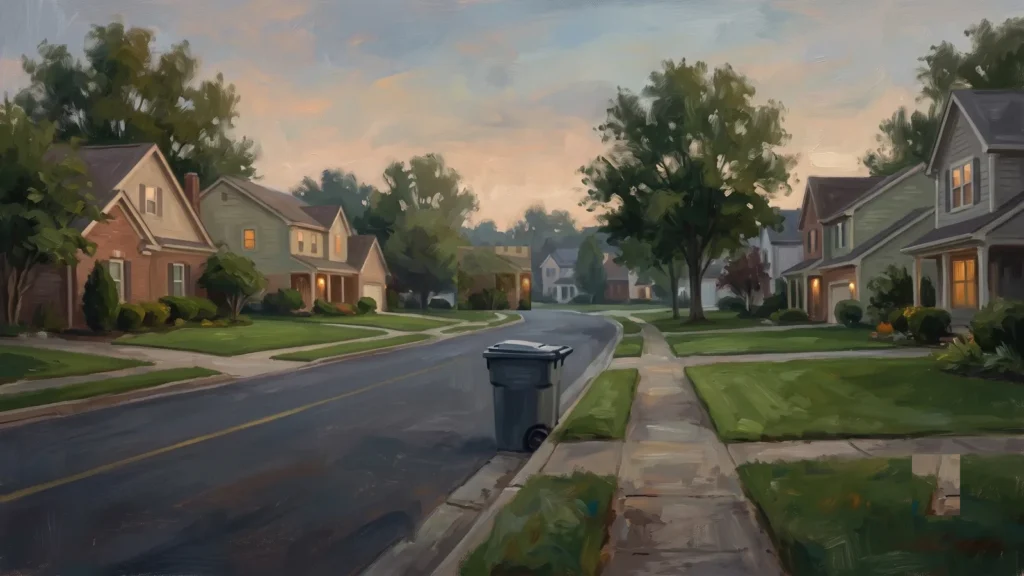
Diane lived two doors down and sat on the HOA architectural committee in our subdivision outside Tulsa, the kind where the bylaws run forty-some pages nobody reads until somebody gets a violation letter. She reported my trash can nine times in four months, always the same complaint: can visible from the street after 7 p.m. on collection day. I got a $25 fine on the third one and a certified letter on the sixth, and by the eighth I could recognize her handwriting on the envelope before I’d even opened it.
I caught her at the mailboxes after the eighth letter. “Diane, is there something else going on here? Eight times, for a trash can.” She didn’t blink. “I’m just enforcing what’s on the books. If everyone followed the rules, nobody would have anything to report.” “Nobody else gets reported eight times for the same can,” I said. “Maybe nobody else keeps doing it,” she said, and went back inside before I could answer.
My wife thought I was overreacting when I told her about it that night. “It’s fifty dollars a month, tops. Just put the can out earlier.” Maybe she was right. But it wasn’t really about the fifty dollars by then. It was the certified letters, the way Diane signed each one in the same blue pen like the bylaws were something she owned personally instead of a document forty other households had also voted on. I’d lived on that street nine years. Nobody else had gotten a single letter that whole time, not for a can, not for anything.
What The Bylaws Actually Said
I pulled the actual document that weekend, the fifty-one pages Diane herself had drafted and pushed through a vote three years earlier when she chaired the committee. I read all of it, not skimming, because I wanted to know exactly what I was allowed to report back. Section 4.2 covered trash cans. Section 6.1 covered exterior holiday lighting, nothing before the Friday after Thanksgiving, down by January 15. Section 7.3 covered detached structures over 120 square feet, permit required. Diane’s own shed, built two summers ago, measured out at 140 square feet on the county assessor’s public site, no permit on file. Her lights had been up since November 3rd two years running, a fact I could prove with time-stamped photos from a doorbell camera angle that happened to catch her porch. Section 5.4, on parking, was one she’d written herself after a fight with a different neighbor over a boat trailer: no vehicle over twenty feet stored in a driveway more than 72 hours without a permit. Her adult son had been keeping a 24-foot camper in her driveway since spring, visiting most weekends, blocking half my sightline every time I backed out.
I didn’t report anything right away. I sat on it for three weeks, mostly curious whether the ninth trash can letter was actually coming. It was, dated a Tuesday, same boilerplate language, another $25.
I told my sister about it on the phone that night, half expecting her to tell me to let it go the way my wife had. She didn’t. “You’ve got a shed that’s twenty feet over, two years of early lights, and a camper that’s basically been squatting in her driveway since spring,” she said. “And she’s fined you nine times for a trash can. I don’t think ‘let it go’ is the move here.” “I don’t want to be the guy who reports his neighbor,” I said. “You’re not reporting a neighbor,” she said. “You’re reading the same document she wrote out loud. That’s different.” I thought about that longer than I expected to.
The Second Conversation
Before I filed anything, I went back to Diane one more time, this time at her front door, the camper visible over her shoulder in the driveway. “I read the bylaws. All of them.” “Good,” she said. “Then you know why the can matters.” “I also know Section 7.3. Your shed’s twenty square feet over the line, no permit.” Her face changed, just slightly. “That’s not the same thing.” “It’s the same document,” I said. “You wrote it.” She told me the shed had a permit somewhere, she just needed to find the paperwork, and shut the door before I could ask about the lights or the camper.
I filed four separate violation reports through the same portal she’d made everyone else use, itemized, with photos, citing the exact sections. Shed: $75 plus a permit-or-remove order. Early lighting, two years running: $50 each. The camper, parked past the 72-hour limit for going on five months: $40 a week, backdated. It came to just over $900, more than my own trash can fines could ever add up to. She’d written the rules. She just hadn’t expected anyone to read them back to her.
The Committee Meeting
Diane brought it up at the next open meeting, called it targeted harassment, asked the board to waive her fines as a professional courtesy since she’d served six years. Walt, the board president, a retired guy who’d been quietly annoyed by Diane’s letters longer than I had, asked whether the bylaws had a courtesy exemption.
“They don’t,” Walt said. “You made sure of that yourself, after the Hendersons tried the same argument over their fence.”
“That was different,” Diane said.
“How?” Walt asked.
“It just is,” Diane said, and reached for her water glass instead of finishing the thought. Walt let it go. He didn’t need to press it; the minutes from three years ago were already in the packet everyone had in front of them.
The fines stood, seven to one, with only Diane’s closest friend on the board voting to waive them. She resigned from the committee eleven days later, citing “time constraints” in a two-line email that went out to the whole distribution list, and the new chair cut trash-can enforcement down to a quarterly newsletter reminder instead of active reporting. I heard later that the newsletter reminder didn’t even mention specific units anymore, just a general note about collection-day timing, which felt like its own kind of apology.
Diane’s husband stopped me in the driveway a few days after the meeting, not angry exactly, more like he was trying to understand something. “She says you went looking for a fight.” “I didn’t go looking for anything,” I said. “She reported my trash can nine times. I read the document she wrote and applied it the same way she applied it to me.” He didn’t have an answer for that. He just nodded, the way people do when they already know the math works out and don’t want to say so out loud. Before he walked back inside, he added, “For what it’s worth, I told her the shed thing would catch up eventually. She didn’t want to hear it.” That was more than I expected from him, and I didn’t push for anything else.
What I Didn’t Do
I never said Diane’s name at the meeting. I didn’t need to; everyone already knew whose shed and whose lights they were. I didn’t report anything untrue, and I didn’t invent a rule to catch her the way she hadn’t invented one to catch me. I just read the same fifty-one pages she’d written and applied them the way they were written, to everyone, on the same public portal she’d insisted on. I also didn’t ask the board to make an example of her, and when someone floated the idea of a follow-up newsletter item naming names, I told them I thought the fines already said everything that needed saying.
A few months later I ran across an unrelated story that stuck with me for the same reason: a manager who required the whole team to itemize every expense down to the dollar, and ended up caught by her own paperwork trail when someone finally cross-referenced the files. You can read what happened to her here. Different building, same math, and the same blind spot: people who write the rules tend to assume the rules stop at their own doorstep.
My trash can still goes out a little early some weeks. Nobody’s reported it since. Diane waves from her driveway now, shorter than she used to, and I wave back, because there’s nothing left to say about it that the bylaws haven’t already covered. Every so often I still think about pulling those fifty-one pages back out, just to see if anything’s changed. So far, nobody’s rewritten them.
Editorial note: This is a work of original fiction. Any resemblance to actual persons or events is coincidental. Read our editorial standards.