
FICTION
My mortgage broker in Raleigh called it a routine document request: three months of bank statements, gift letters if any family money was involved, standard stuff for an FHA loan. I told her there was no family money involved. My parents had been clear about that for two years, ever since I first asked about help with a down payment and got a long, patient explanation about their fixed income and my father’s knee surgery.
My sister Kayla bought her house eighteen months ago, four bedrooms in a new development outside Charlotte, the kind of place with a name like Somerset Ridge and a homeowners association that fines you for a trash can left out past Tuesday. When she closed, she told the family it was “mostly savings and a good rate.” I believed her. I had no reason not to.
The Statement That Did Not Belong To Me
The broker’s underwriter flagged an account during my credit pull, a joint account at a credit union two states away that listed me as a secondary holder. I had never opened it, never used a card tied to it, never heard of it. When I called the credit union, a rep confirmed my parents had added me as a joint owner nine years ago, back when I was in college, “for estate purposes,” and never removed me. The transaction history was public once I had access, and I looked, because by then I already suspected what I’d find.
In March of last year, two wire transfers moved through that account: $41,000 out to a title company in Charlotte, and eleven months later, $890 a month coming back in from an account labeled “K. Whitfield Mortgage Reimb.” My parents hadn’t just helped Kayla with her down payment. They’d structured it as a loan through a shared account with my name still on it, and Kayla had been quietly repaying them every month, off the books, while telling everyone it was savings.
I called my broker back before I said anything to anyone in the family. “Does this affect my application?” I asked her. “Not directly,” she said. “But if you want, I can pull the full account history so you know what you’re looking at before you bring it up.” I told her to send it. It took two days to arrive, and by the time it did I’d already done the math myself, twice, on a legal pad at my kitchen table, because I wanted to be wrong about it and I wasn’t.
Thanksgiving, Eleven Months Later
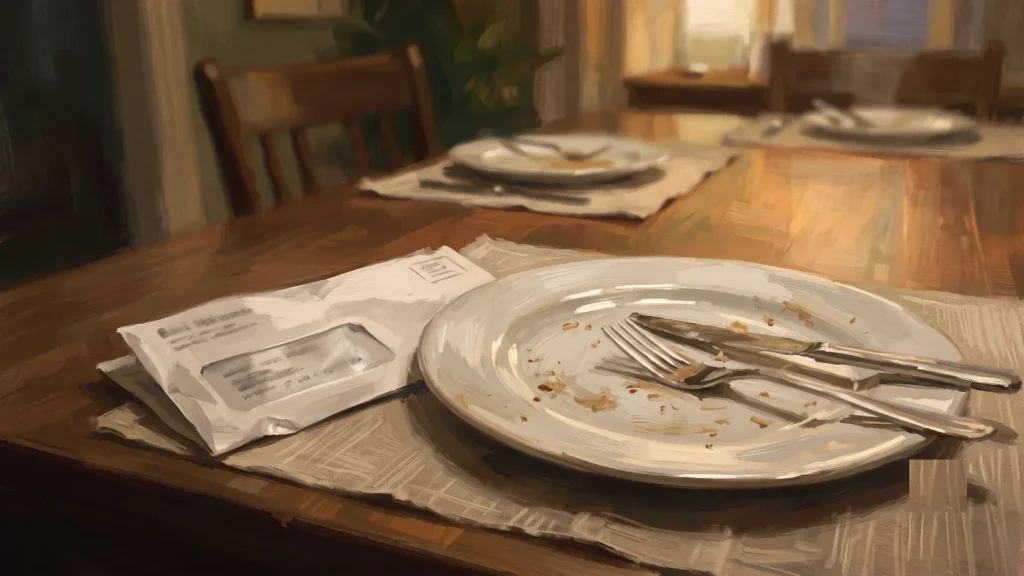
I brought the printed statements to Thanksgiving, folded in an envelope, and set them next to the sweet potatoes without a word until after the plates were cleared. My mother’s face did the thing it does when she’s deciding whether to lie, a half-second pause, and then she asked where I’d gotten them.
“My name is still on the account,” I said. “I didn’t go looking. The bank looked for me.”
“It wasn’t supposed to matter,” she said. “It was just easier to leave your name on it than open a new one.”
“Easier for who,” I said. Not a question.
My father tried the fixed-income explanation again, out of habit more than conviction, and stopped himself halfway through. “We didn’t want you to feel—” he started.
“Feel what,” I said. “Like there was something to give and you gave it to her instead?”
My mother’s mouth opened and closed once, no words in it. Kayla looked at her plate the way you look at something you’d rather not explain, and my mother reached over and put her hand flat on the table like she could hold the whole conversation still.
She told everyone it was savings. It was a loan, and my name was on the paperwork the whole time.
“Why didn’t you just tell me?” I asked. “Two years ago, when I first asked. You could have said ‘we’re helping Kayla instead’ and I would have understood that. What I don’t understand is being told there was nothing.” My mother didn’t have a fast answer for that one. “Because there wasn’t supposed to be a comparison,” she finally said. “It wasn’t about you not getting something. It was about her needing it first.” “It’s still a comparison,” I said. “You just didn’t let me see the numbers.”
What They Offered
They offered to do the same for me, retroactively, a matching $41,000 structured the same way, as if the number was the injury and not the nine years of being told there was nothing to give. I said no. Not because I didn’t want the money. Because I didn’t want a joint account with my name quietly attached to it, doing math I couldn’t see, for another decade.
“So what do you want,” my mother asked, and for once it didn’t sound like a rhetorical question.
“My name off the account. That’s it.” She agreed within the week, mailed me the confirmation letter from the credit union like it was a peace offering. It probably was, in its way.
My father, who hadn’t said much since the fixed-income line, caught me alone by the coat closet on my way out. “For what it’s worth,” he said, “we should have told you when you first asked. Not after.” “Why didn’t you?” I asked. “Because it’s easier to explain a no than a not yet,” he said, “and by the time it stopped being a not yet, we didn’t know how to bring it back up.” It wasn’t really an apology. It was close enough that I let it stand as one.
The Landing
I got my own mortgage two months later, no family money, a slightly higher rate than Kayla’s, a smaller house than Somerset Ridge. My parents still call it “your sister’s situation” when it comes up, which is not quite the same as calling it what it was. Kayla and I talk less than we used to. Not a fight. Just less.
She called me once, a few months after Thanksgiving, and asked if I was still angry. “Not at you,” I said. “I don’t think you asked for the account to have my name on it.” “I didn’t,” she said. “I didn’t even know until you brought the statements.” We didn’t solve anything on that call. We just agreed we’d both been handed a version of the same story, and only one of us had gotten to hear it from the beginning. She asked if I thought our parents would ever just say things plainly instead of managing them. I told her I didn’t know, and that I’d stopped waiting to find out.
My father called a few weeks after that, on a Tuesday for no particular reason, and we talked about nothing in particular for twenty minutes before he mentioned, almost as an aside, that he’d started keeping a folder of his own now, copies of everything, in case anyone ever needed to ask again. I didn’t know what to do with that except say it sounded like a good idea.
Related reading: families rarely put the real terms of financial help in writing until someone forces the question — this account of a wedding paid for with strings nobody mentioned out loud covers a similar pattern from the other side of a different ceremony entirely.
My mortgage closed on a Thursday in February, no joint accounts, no names I hadn’t put there myself. I keep every statement now, mine and anyone else’s I’m ever asked to sign onto, in a folder I check on the first of the month whether anything’s changed or not.
Editorial note: This is a work of original fiction. Any resemblance to actual persons or events is coincidental. Read our editorial standards.